



Bronze vs. Silver vs. Gold Health Insurance Plans: Which Marketplace Plan Is Right for You?
By the Health Insurance Santa Claus
Choosing a health insurance plan isn’t just about finding the lowest monthly premium. It’s about protecting your finances, ensuring you have access to quality healthcare, and selecting coverage that fits your lifestyle, medical needs, and budget.
Every year, millions of Americans shopping through the Health Insurance Marketplace are faced with the same question:
Should I choose a Bronze, Silver, or Gold health insurance plan?
The answer isn’t the same for everyone.
At Health Insurance Santa Claus, we help families throughout Florida and across the country compare their options from multiple insurance companies so they can make an informed decision, not just the cheapest one.
Let’s break down exactly what each metal level means and how to determine which one may be the best fit for your situation.
What Do Bronze, Silver, and Gold Actually Mean?
One of the biggest misconceptions about Marketplace insurance is that Gold plans provide better doctors or higher-quality medical care than Bronze plans.
They don’t.
According to HealthCare.gov, the metal levels simply describe how you and the insurance company share healthcare costs, not the quality of care you’ll receive.
Every Marketplace health insurance plan covers the ten Essential Health Benefits required under the Affordable Care Act, including:
- Preventive care
- Emergency services
- Hospitalization
- Prescription drugs
- Maternity care
- Mental health services
- Pediatric care
- Laboratory services
- Rehabilitative services
- Chronic disease management
The primary differences between Bronze, Silver, and Gold plans are:
- Monthly premiums
- Deductibles
- Copays
- Coinsurance
- Maximum out-of-pocket costs
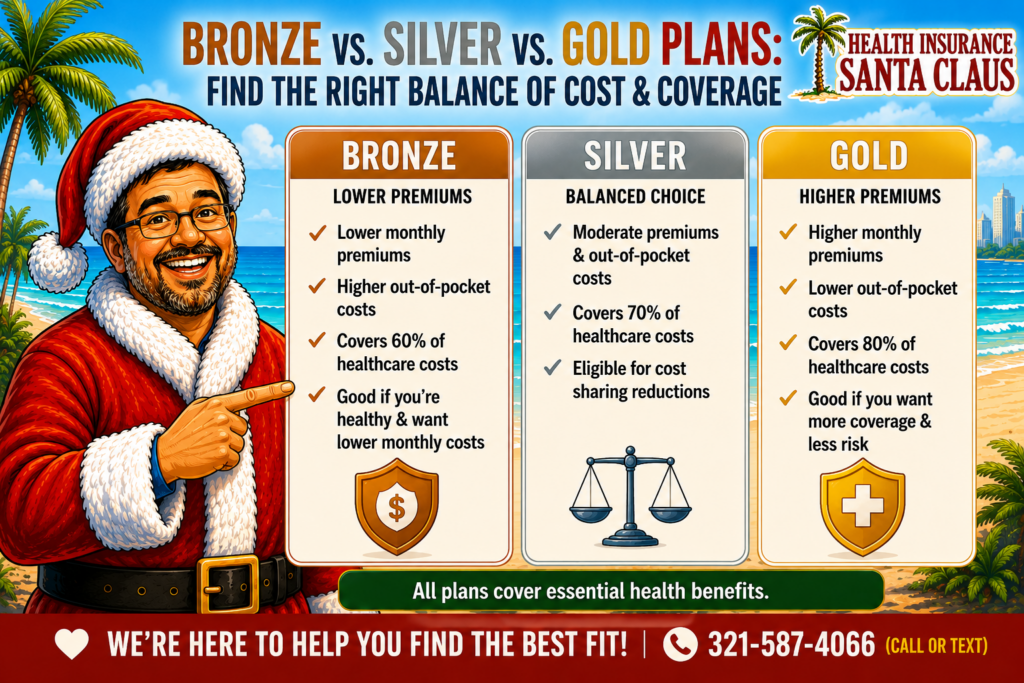
Bronze Plans: Lower Monthly Premiums
Bronze plans generally have the lowest monthly premium but require you to pay more when you actually receive healthcare.
HealthCare.gov estimates that Bronze plans are designed to pay about 60% of covered healthcare expenses, while the enrollee pays approximately 40% through deductibles, copays, and coinsurance.
Bronze plans may be a good choice if you:
- Rarely visit the doctor
- Are generally healthy
- Want protection from catastrophic medical bills
- Need the lowest possible monthly payment
- Have savings available if an unexpected illness occurs
Advantages
✔ Lowest monthly premiums
✔ Protection against major medical expenses
✔ Preventive services remain covered
Considerations
- Higher deductibles
- Higher out-of-pocket costs
- More financial responsibility before insurance begins paying
For many young adults and healthy families, Bronze plans can make excellent financial sense.
Silver Plans: The Best Balance for Many Families
Silver plans often provide the best overall value because they strike a balance between premiums and out-of-pocket costs.
Marketplace Silver plans generally pay around 70% of covered healthcare expenses, leaving the member responsible for approximately 30%.
However…
Silver plans have one feature that no other metal level offers.
Cost-Sharing Reductions (CSR)
If your household income qualifies, enrolling in a Silver Marketplace plan may unlock Cost-Sharing Reductions (CSR).
These additional savings can reduce:
- Deductibles
- Copays
- Coinsurance
- Maximum out-of-pocket expenses
HealthCare.gov explains that Cost-Sharing Reductions are only available on Silver Marketplace plans, even if you qualify for premium tax credits on Bronze or Gold plans.
For many lower- and moderate-income households, this can dramatically increase the value of a Silver plan.
In some cases, a Silver plan with Cost-Sharing Reductions may actually provide benefits comparable to, or even better than, a standard Gold plan.
Gold Plans: Higher Premiums, Lower Medical Costs
Gold plans generally have the highest monthly premiums.
However, they also provide more financial protection when you actually use healthcare services.
According to HealthCare.gov, Gold plans are designed to cover approximately 80% of covered medical expenses, leaving members responsible for roughly 20%.
Gold plans may be an excellent option if you:
- See specialists frequently
- Take expensive prescription medications
- Have chronic medical conditions
- Anticipate surgery
- Want more predictable healthcare costs
Although you’ll pay more every month, many individuals save money overall if they consistently use healthcare throughout the year.
Don’t Choose Based Only on Monthly Premiums
This is one of the biggest mistakes consumers make.
A lower premium doesn’t necessarily mean lower overall healthcare costs.
Imagine two people:
Person A
Pays:
- $250/month premium
But has:
- $8,000 deductible
Person B
Pays:
- $420/month premium
But has:
- $750 deductible
If Person A experiences a hospitalization, they could easily spend thousands more than Person B despite paying lower monthly premiums.
That’s why experienced insurance brokers evaluate:
- Expected doctor visits
- Prescriptions
- Specialist usage
- Planned surgeries
- Financial goals
- Household income
- Tax credits
- Cost-sharing reductions
before recommending a plan.
Premium Tax Credits Can Change Everything
Many Marketplace consumers qualify for premium tax credits that lower monthly premiums.
These tax credits are available on Bronze, Silver, Gold, and Platinum Marketplace plans if you qualify. HealthCare.gov determines eligibility based on information such as your household size and estimated annual income.
Your estimated annual income can dramatically impact:
- Monthly premiums
- Available plans
- Tax credits
- Cost-sharing reductions
Accurately estimating your income is extremely important.
Other Important Factors to Compare
Choosing a Marketplace plan isn’t just about Bronze versus Silver versus Gold.
You should also compare:
Provider Networks
Always verify that your:
- Primary Care Physician
- Specialists
- Children’s doctors
- Preferred hospitals
participate in the network.
Prescription Drug Coverage
Not every insurance company covers medications the same way.
Review:
- Formulary
- Drug tiers
- Prior authorization requirements
- Mail-order options
Maximum Out-of-Pocket Limit
This number is often overlooked.
It’s the most you’ll pay during the year for covered healthcare services before your insurance begins paying 100% of covered costs.
Deductibles
Some plans have:
- Medical deductibles
- Prescription deductibles
- Separate deductibles for different services
Understanding how these work can prevent expensive surprises.
When Does Gold Actually Save Money?
Many consumers assume Gold plans are “too expensive.”
Sometimes they’re actually cheaper overall.
If someone:
- Visits multiple specialists
- Takes high-cost medications
- Receives ongoing treatment
- Needs physical therapy
- Has diabetes
- Has heart disease
A higher premium may be offset by lower deductibles, copays, and coinsurance.
The key is looking at your total expected annual healthcare costs, not just the monthly premium.
Financial Planning and Health Insurance
Health insurance is one of the most important components of a long-term financial plan.
Many financial advisors emphasize planning for healthcare costs when building retirement and wealth strategies. Resources from firms like Raymond James discuss healthcare expenses as a significant retirement planning consideration and encourage reviewing insurance choices as part of an overall financial strategy. (See the healthcare and retirement planning resources available through Raymond James.)
Likewise, the Marketplace emphasizes comparing not only premiums but also deductibles, provider networks, prescription coverage, and total out-of-pocket exposure before selecting a plan.
What Experienced Insurance Brokers Recommend
Well-established insurance agencies often advise clients to evaluate:
- Total annual healthcare costs
- Expected doctor visits
- Prescription expenses
- Family medical history
- Income-based subsidies
- Provider networks
Large independent agencies with strong consumer reputations, such as HealthSherpa’s educational resources and Ritter Insurance Marketing’s Marketplace education for agents, also emphasize comparing the total cost of coverage rather than choosing a plan solely because it has the lowest premium. This aligns with the guidance published by HealthCare.gov.
Which Plan Is Right for You?
Here’s a simple starting point:
Bronze
Consider if you:
- Rarely visit the doctor
- Want the lowest monthly premium
- Can comfortably handle higher out-of-pocket costs if unexpected care is needed
Silver
Consider if you:
- Want balanced monthly costs and cost-sharing
- May qualify for Cost-Sharing Reductions
- Expect occasional doctor visits or prescriptions
Gold
Consider if you:
- Frequently use healthcare
- Prefer lower deductibles and copays
- Want more predictable annual healthcare expenses
Remember that these are general guidelines. The best choice depends on your personal health needs, financial situation, provider preferences, and eligibility for financial assistance.
Let the Health Insurance Santa Claus Help
Health insurance isn’t one-size-fits-all.
The “best” plan isn’t necessarily the Bronze, Silver, or Gold plan—it’s the one that fits your needs and budget.
At Health Insurance Santa Claus, we help individuals, families, self-employed professionals, early retirees, and small business owners compare Marketplace plans from multiple insurance carriers. We’ll review your doctors, prescriptions, anticipated healthcare needs, and eligibility for premium tax credits or Cost-Sharing Reductions so you can make an informed decision with confidence.
Whether you’re enrolling for the first time, changing plans, or simply wondering if you’re overpaying, we’re here to help simplify the process.
Call or Text: 321-587-4066
Visit HealthInsuranceSantaClaus.com to schedule your free consultation and let us help you find the right balance of cost and coverage.
Helpful Resources
- HealthCare.gov – Health Plan Categories (Bronze, Silver, Gold & Platinum)
- HealthCare.gov – Cost-Sharing Reductions Explained
- HealthCare.gov – How Marketplace Premiums Are Determined
- Raymond James – Retirement & Financial Planning Resources
- HealthSherpa Learning Center
- Ritter Insurance Marketing – ACA & Marketplace Education