

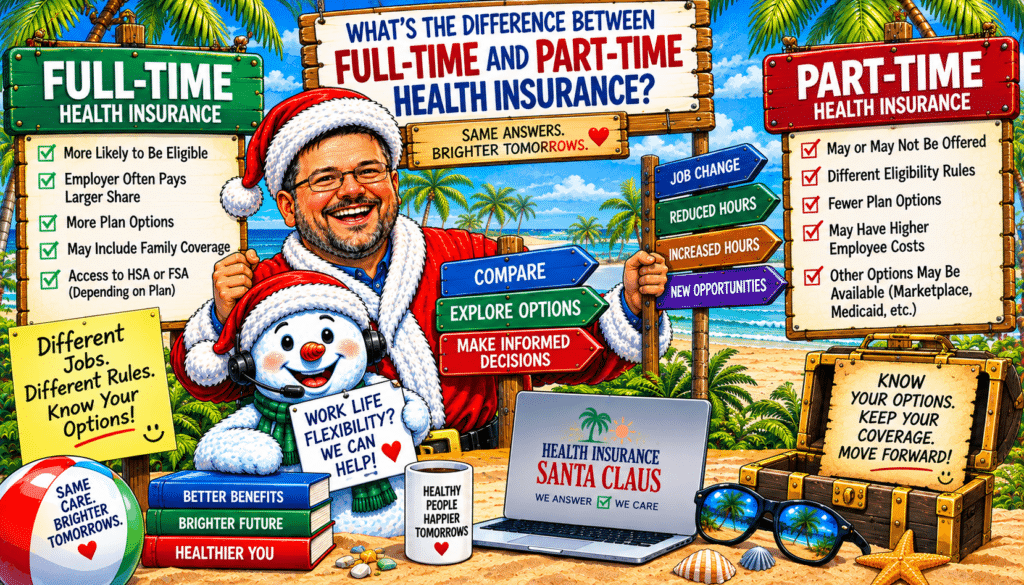
What’s the Difference Between Full-Time and Part-Time Health Insurance?
If you’ve ever moved from a full-time job to part-time work—or considered doing so—you may have wondered:
“What happens to my health insurance?”
The answer isn’t always straightforward.
Some employers offer health insurance to eligible part-time employees.
Others don’t.
Some employers use different eligibility rules for different classes of employees.
And depending on your circumstances, you may have other options outside your employer.
That’s why understanding the difference between full-time and part-time health insurance can be extremely important before changing your work schedule.
Does Full-Time Automatically Mean Health Insurance?
Not necessarily.
A job being classified as “full-time” doesn’t mean every employer offers identical health benefits.
Employer health plans have eligibility rules.
The important question is:
What does the employer’s health plan say about eligibility?
Ask for the company’s benefits information and determine exactly who qualifies.
Does Part-Time Automatically Mean No Health Insurance?
No.
This is another common misconception.
Some employers offer health benefits to certain part-time employees.
Others may provide different benefit options based on employee classifications.
The Department of Labor has explained that the ACA’s 90-day waiting-period limitation is not based simply on whether an employee is full-time or part-time.
The important issue is whether the employee is otherwise eligible under the terms of the plan.
Why Does Employment Status Matter?
Employment status can affect eligibility for an employer’s health benefits.
An employer might classify employees into groups such as:
- Full-time
- Part-time
- Seasonal
- Hourly
- Salaried
- Certain job classifications
Different rules may apply depending on the employer’s plan and applicable requirements.
That’s why you should ask for the actual benefit eligibility rules rather than relying on assumptions.
What If You Reduce Your Hours?
Imagine you currently work 40 hours per week.
You decide to reduce your schedule to 25 hours.
Before making the change, ask your employer:
“Will reducing my hours affect my health insurance?”
Don’t wait until after your schedule changes.
You want to know:
- Whether coverage continues
- Whether your premium changes
- Whether dependents remain covered
- Whether you lose eligibility
- Whether another enrollment opportunity applies
What If You Increase Your Hours?
The opposite can also happen.
Maybe you currently work part-time and accept additional hours.
Ask:
“When would I become eligible for the full-time health plan?”
And ask:
“When would the new coverage become effective?”
Be careful not to assume that changing your hours automatically means your insurance changes immediately.
What If You Lose Employer Coverage?
If a change in employment status causes you to lose employer-sponsored coverage, you may have other options.
HealthCare.gov explains that losing job-based coverage can qualify you for a Special Enrollment Period for Marketplace coverage. Generally, you have 60 days after losing qualifying job-based coverage to enroll.
You may also have access to COBRA depending on your circumstances.
Marketplace Coverage May Be an Option
Marketplace insurance isn’t only for people who are unemployed.
It can also be an option for people working part-time who don’t have qualifying employer coverage.
Depending on household income and other circumstances, you may qualify for financial assistance.
However, an offer of affordable employer-sponsored coverage that meets minimum standards can affect eligibility for Marketplace premium tax credits.
For 2026, HealthCare.gov states that employer coverage is considered affordable under the applicable federal test when the employee’s share of the lowest-cost plan’s monthly premium is less than 9.96% of household income.
That’s why you should compare the actual offer rather than simply deciding that Marketplace coverage is cheaper.
What About Medicaid?
If reducing your hours causes your household income to fall, you may also want to check whether you qualify for Medicaid or CHIP.
HealthCare.gov allows people to apply for Medicaid and CHIP year-round when eligible.
Eligibility varies based on circumstances and state rules.
What Happens to Your Deductible?
Changing from one employer plan to another can have important consequences for your deductible.
If you lose your current employer plan and enroll in a completely different plan, don’t assume your deductible accumulation automatically follows you.
For example:
You’ve paid $2,000 toward a $3,000 deductible.
You move to another plan with a $3,000 deductible.
The new plan may have its own deductible accumulation.
This is one reason timing a job or employment-status change can matter.
Compare More Than the Premium
When evaluating full-time versus part-time coverage, compare:
- Monthly premium
- Deductible
- Copays
- Coinsurance
- Out-of-pocket maximum
- Prescription coverage
- Provider network
- Hospital network
- Family coverage
- Employer contribution
HealthCare.gov recommends comparing total estimated healthcare costs rather than looking only at monthly premiums.
What About HSA and FSA Benefits?
Some employer health plans come with tax-advantaged accounts such as HSAs or FSAs.
HealthCare.gov explains that HSAs can allow eligible individuals to set aside pre-tax money for qualified medical expenses, while FSAs are another type of employer-sponsored account.
If you’re comparing employment arrangements, find out whether these benefits change when you move between full-time and part-time status.
What If Your Employer Offers an HRA?
Some employers use an HRA instead of—or in addition to—traditional group health coverage.
An Individual Coverage HRA can be offered to certain employee classes, including full-time or part-time employees, subject to applicable rules.
If your employer offers an HRA, don’t assume it works exactly like traditional group insurance.
Ask how it works and how it affects your other coverage options.
Questions to Ask Your Employer
Before changing from full-time to part-time, ask:
Will I remain eligible for health insurance?
Will my premium change?
Will my deductible change?
Will my dependents remain covered?
Will my network change?
Will my HSA or FSA eligibility change?
When would any change become effective?
What happens if I later return to full-time employment?
These questions can prevent unpleasant surprises.
Final Thoughts
Full-time versus part-time employment doesn’t automatically tell you what your health insurance situation will be.
Your employer’s benefit eligibility rules matter.
Your hours matter.
Your household income matters.
And your alternatives matter.
Before changing your work schedule, find out exactly what happens to your health insurance.
At Health Insurance Santa Claus, we help individuals and families understand their options when employment circumstances change.
Before you change your hours, check your health insurance.