



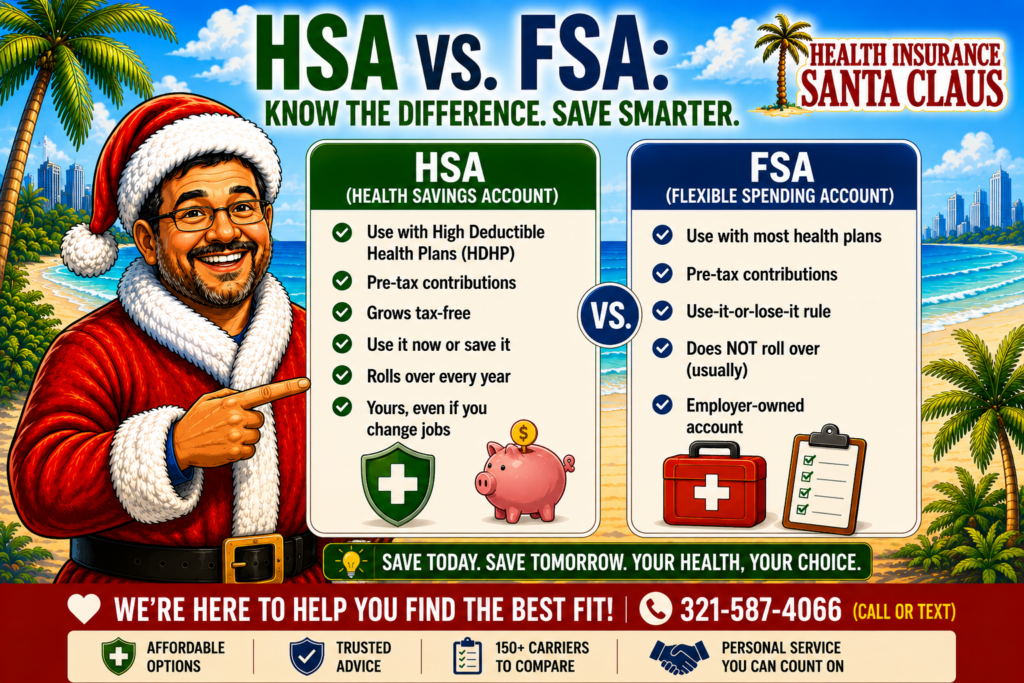
HSA vs. FSA: What’s the Difference and Which One Is Right for You?
By The Health Insurance Santa Claus
When it comes to saving money on healthcare, one of the most common questions I hear is:
“What’s the difference between an HSA and an FSA?”
At first glance, they sound almost identical. Both allow you to use pre-tax dollars to pay for qualified medical expenses. Both can lower your taxable income. Both can help you save money.
However, that’s where the similarities begin to end.
Understanding the differences between a Health Savings Account (HSA) and a Flexible Spending Account (FSA) can save you hundreds or even thousands of dollars each year. Choosing the wrong one for your situation could also cost you money if you don’t understand the rules.
Let’s break everything down.
What Is an HSA?
A Health Savings Account (HSA) is a tax-advantaged savings account available to people enrolled in a qualified High Deductible Health Plan (HDHP).
Think of an HSA as a combination of a healthcare checking account and a retirement account.
Money contributed goes in before taxes (or is tax deductible), grows tax-free, and can be withdrawn tax-free when used for qualified medical expenses. This “triple tax advantage” is one of the biggest reasons financial professionals often view HSAs as one of the most powerful savings vehicles available.
Benefits of an HSA
- Pre-tax contributions
- Tax-free growth
- Tax-free withdrawals for qualified medical expenses
- Funds roll over every year
- You own the account
- The money stays with you if you change jobs
- Many HSAs allow investing your balance once minimum thresholds are met
What Is an FSA?
A Flexible Spending Account (FSA) is an employer-sponsored benefit that also lets employees contribute pre-tax money for qualified healthcare expenses.
Unlike an HSA, an FSA generally isn’t tied to a High Deductible Health Plan. Many traditional PPO and HMO plans offer FSAs.
The biggest difference?
Most FSAs follow the “use-it-or-lose-it” rule.
That means if you don’t spend your elected balance by your employer’s deadline, you may lose the remaining funds. Some employers allow a limited rollover or grace period, but those rules vary by plan.
Benefits of an FSA
- Pre-tax payroll deductions
- Available with many employer health plans
- Immediate access to your annual election amount for eligible expenses
- Great for predictable healthcare costs
Side-by-Side Comparison
| Feature | HSA | FSA |
|---|---|---|
| Requires HDHP | ✅ Yes | ❌ No |
| Pre-tax contributions | ✅ Yes | ✅ Yes |
| Tax-free qualified withdrawals | ✅ Yes | ✅ Yes |
| Money rolls over | ✅ Unlimited | Usually No |
| You own the account | ✅ Yes | ❌ Employer |
| Portable if changing jobs | ✅ Yes | Usually No |
| Can be invested | ✅ Often | ❌ No |
| Use-it-or-lose-it | ❌ No | ✅ Usually |
The Triple Tax Advantage of an HSA
Financial advisors frequently describe the HSA as offering a unique triple tax benefit:
1. Contributions reduce taxable income
Money contributed through payroll deductions is generally pre-tax.
2. Investment growth is tax-free
Unlike many savings accounts, earnings and investment gains inside an HSA aren’t taxed when they remain in the account.
3. Qualified withdrawals are tax-free
When used for eligible medical expenses, withdrawals aren’t taxed.
This combination makes HSAs unique compared with many other savings tools.
Can an HSA Become a Retirement Account?
Many people don’t realize this.
If you don’t spend your HSA during your working years, you can continue allowing it to grow.
After age 65:
- Qualified medical expenses remain tax-free.
- Non-medical withdrawals are generally taxed like distributions from a traditional retirement account (without the additional penalty that applies before age 65).
Because healthcare is one of retirement’s largest expenses, many financial planners encourage long-term HSA savings when appropriate.
When Does an FSA Make Sense?
An FSA can be an excellent option if you know you’ll have predictable healthcare expenses during the year.
Examples include:
- Prescription medications
- Ongoing specialist visits
- Physical therapy
- Glasses
- Contact lenses
- Dental work
- Orthodontics
- Childbirth expenses
- Planned surgeries
Since you generally must use the funds during the plan year (subject to your employer’s specific rules), estimating your expected expenses carefully is important.
What Can You Buy With an HSA or FSA?
Both accounts typically cover many IRS-qualified medical expenses, including:
- Doctor visits
- Hospital bills
- Prescription medications
- Lab work
- Diagnostic imaging
- Dental care
- Vision exams
- Eyeglasses
- Contact lenses
- Hearing aids
- Many over-the-counter medical products
The IRS maintains the official list of qualified medical expenses in Publication 502.
Common Mistakes People Make
Mistake #1: Choosing an HSA Without Understanding the Deductible
An HSA requires enrollment in an eligible High Deductible Health Plan.
That lower premium may not be ideal if you expect significant healthcare expenses throughout the year.
Mistake #2: Forgetting About FSA Deadlines
Every year, employees lose money simply because they forget to use their remaining FSA balance before the deadline.
Understanding your employer’s rollover or grace-period policy can help prevent unnecessary forfeitures.
Mistake #3: Not Investing HSA Funds
Many HSA account holders leave substantial balances sitting in low-interest cash accounts.
Depending on your HSA provider and your financial goals, investing a portion of long-term HSA savings may provide greater growth potential.
Which Account Is Better?
The answer depends entirely on your situation.
An HSA may be better if:
- You’re relatively healthy.
- You qualify for an HDHP.
- You want long-term tax-advantaged savings.
- You’re thinking about retirement planning.
- You like investment flexibility.
An FSA may be better if:
- You have predictable annual medical expenses.
- Your employer offers one.
- You prefer a traditional health plan.
- You expect to use most or all of the money during the plan year.
Helpful Resources You Can Trust
When researching HSAs and FSAs, it’s important to rely on authoritative sources rather than marketing claims. Here are several excellent references:
Government Resources
- IRS Publication 969 – Health Savings Accounts and Other Tax-Favored Health Plans
- IRS Publication 502 – Medical and Dental Expenses
- U.S. Office of Personnel Management – Health Savings Accounts Overview
Financial Institution Resources
- Raymond James – Financial Planning Resources
- Fidelity HSA Learning Center
- Bank of America HSA Education Center
Insurance Broker Educational Blogs
The following agencies have strong reputations and hundreds of positive customer reviews while providing educational health insurance content:
(Review counts can change over time, so verify current Google Business review totals before citing them in marketing materials.)
Final Thoughts from the Health Insurance Santa Claus
Choosing between an HSA and an FSA isn’t about finding a universally “better” option, it’s about finding the one that aligns with your health needs, financial goals, and the type of health plan available to you.
If you’re looking to build long-term, tax-advantaged savings and qualify for a high-deductible health plan, an HSA can be a powerful financial tool. If you expect regular medical expenses during the year and have access to an employer-sponsored FSA, that option can also provide meaningful tax savings.
The key is understanding the rules before you enroll.
At the Health Insurance Santa Claus, our goal is to help individuals, families, retirees, and business owners understand their health insurance options not just choose a plan, but make informed decisions that support their overall financial well-being.
Whether you’re enrolling for the first time, changing jobs, approaching Medicare eligibility, or simply reviewing your benefits during Open Enrollment, I’d be happy to help you understand how HSAs, FSAs, and your health insurance work together.
Have questions about your health insurance? Contact us by clicking here.
This article is intended for educational purposes only and should not be considered tax, legal, or investment advice. Always consult your tax professional or financial advisor regarding your individual circumstances.