



Affordable Care Act Marketplace vs. Private Health Insurance: Which One Is Right for You?
A Complete Guide from the Health Insurance Santa Claus
Choosing health insurance has never been more confusing. Between television commercials, social media ads, government websites, and insurance companies all promoting different options, many people are left wondering:
Should I enroll in a Marketplace (ACA) health insurance plan, or should I consider a private health insurance plan?
The truth is, there isn’t a one-size-fits-all answer. The best plan depends on your income, health, budget, doctor preferences, and future healthcare needs.
At Health Insurance Santa Claus, our mission isn’t to push one type of plan over another. Our goal is to educate you on all of your available options so you can make an informed decision.
Let’s break down the differences.
What is Marketplace Health Insurance?
Marketplace health insurance, often called ACA (Affordable Care Act) insurance, is coverage offered through the federal Health Insurance Marketplace at HealthCare.gov or through your state’s Marketplace exchange.
These plans were created under the Affordable Care Act to provide comprehensive health coverage while protecting consumers from being denied coverage because of pre-existing medical conditions. The Marketplace also allows eligible individuals and families to receive premium tax credits and cost-sharing reductions based on household income.
Marketplace plans include:
- Guaranteed acceptance regardless of health history
- Coverage for pre-existing medical conditions
- Essential Health Benefits required by federal law
- Annual out-of-pocket maximums
- Income-based financial assistance for eligible applicants
- Standardized metal levels (Bronze, Silver, Gold, and Platinum)
For millions of Americans, especially those who qualify for subsidies, Marketplace plans provide affordable access to comprehensive coverage.
What is Private Health Insurance?
Private health insurance refers to plans purchased directly from an insurance company or through a licensed insurance broker instead of through the Marketplace.
It’s important to understand that “private health insurance” is a broad category.
Some private plans are:
- ACA-compliant plans sold off-exchange
- Employer-sponsored plans
- Association-based coverage (when available)
- Medically underwritten individual plans (where permitted)
- Supplemental insurance products
Depending on the type of plan, eligibility rules, underwriting requirements, provider networks, and benefits may differ. HealthCare.gov notes that some plans sold outside the Marketplace qualify as comprehensive coverage, while others may not. Consumers should always review the Summary of Benefits and Coverage before enrolling.
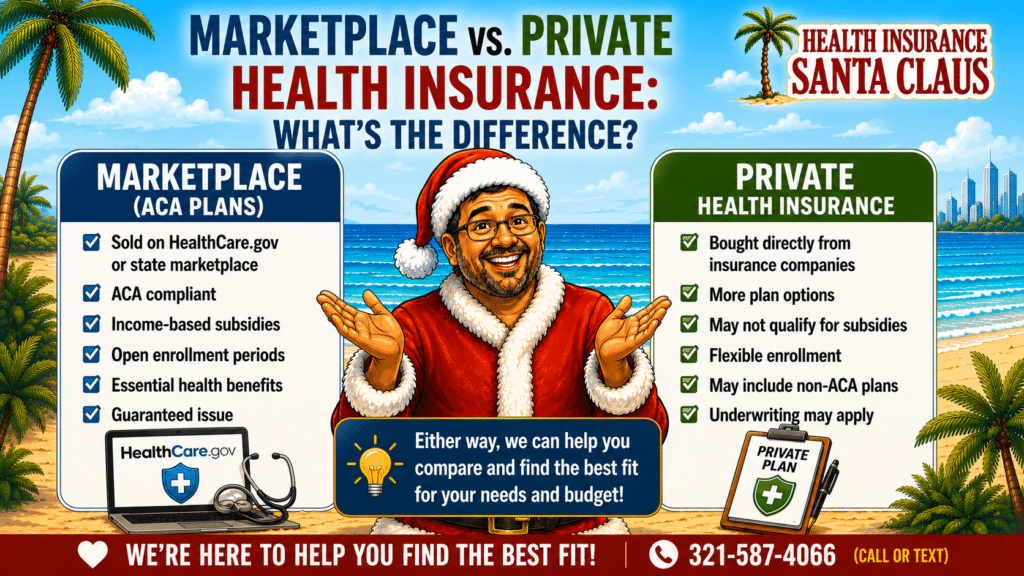
Marketplace vs. Private Health Insurance
Marketplace Plans
Marketplace plans are generally best known for consumer protections.
Advantages
✔ Guaranteed issue
You cannot be declined because of:
- Diabetes
- Heart disease
- Cancer
- Pregnancy
- Asthma
- Previous surgeries
- Any pre-existing medical condition
✔ Income-based subsidies
Many families qualify for premium tax credits that reduce monthly premiums.
The lower your household income (within eligibility guidelines), the larger your subsidy may be. The IRS explains that advance premium tax credits are reconciled on your federal tax return using Form 1095-A and Form 8962.
✔ Comprehensive coverage
Every ACA Marketplace plan includes Essential Health Benefits, such as:
- Preventive care
- Hospitalization
- Emergency services
- Prescription drugs
- Mental health care
- Maternity care
- Pediatric services
- Laboratory services
Potential disadvantages
Marketplace plans may have:
- Higher premiums if you do not qualify for subsidies
- Narrow provider networks in some areas
- Limited PPO availability depending on your state
- Enrollment generally restricted to Open Enrollment or Special Enrollment Periods.
Private Health Insurance
Private health insurance can offer additional flexibility for some consumers, but it is not automatically better than Marketplace coverage.
Possible advantages
Depending on the insurer and product, private plans may offer:
- Additional plan designs
- Different provider network options
- Flexible enrollment opportunities for certain products
- Coverage that may fit individuals who do not qualify for Marketplace financial assistance
Some comprehensive ACA-compliant plans are sold directly by insurers outside the Marketplace, while other products are medically underwritten or provide limited benefits.
Possible disadvantages
Some private plans:
- May require medical underwriting
- May not accept every applicant
- May exclude pre-existing conditions (for medically underwritten products)
- Do not qualify for Marketplace premium tax credits if purchased outside the Marketplace.
Which One Costs Less?
This is probably the question we hear the most.
The honest answer is:
It depends.
Several factors influence your total healthcare costs, including:
- Household income
- Family size
- County of residence
- Tobacco use
- Age
- Available tax credits
- Health status (for products that use underwriting)
- Preferred doctors and hospitals
- Prescription medications
The lowest monthly premium does not always result in the lowest overall healthcare costs. Deductibles, copays, coinsurance, provider networks, and out-of-pocket maximums all play an important role.
Don’t Focus Only on the Monthly Premium
One of the biggest mistakes consumers make is shopping only by premium.
Instead, ask:
- Is my primary care physician in-network?
- Are my specialists covered?
- Are my prescriptions on the formulary?
- What is my deductible?
- What is my maximum out-of-pocket limit?
- What happens if I’m hospitalized?
Sometimes paying a slightly higher premium results in thousands of dollars in savings if you need medical care.
Common Myths About Health Insurance
Myth #1:
“I have to buy through HealthCare.gov.”
Not necessarily.
Some comprehensive plans are available outside the Marketplace. Whether they are the right fit depends on your individual circumstances.
Myth #2:
“Private insurance is always cheaper.”
Not true.
If you qualify for premium tax credits, Marketplace coverage may be significantly more affordable than other options.
Myth #3:
“Marketplace insurance has bad coverage.”
Not necessarily.
Every Marketplace plan must meet ACA standards for essential health benefits and consumer protections. The difference between plans often comes down to provider networks, cost-sharing, and premiums—not whether they cover the required benefit categories.
Myth #4:
“An insurance broker costs extra.”
Licensed health insurance agents and brokers are generally compensated by insurance companies, not by charging consumers an additional fee for enrollment. Using a broker does not typically increase your premium.
Why Working With a Broker Matters
Shopping for health insurance on your own can be overwhelming.
A licensed broker can help you compare:
- Marketplace plans
- Off-exchange ACA plans (where available)
- Provider networks
- Prescription drug coverage
- Deductibles
- Maximum out-of-pocket costs
- Premium tax credit eligibility
- Enrollment rules
Instead of spending hours researching dozens of plans, an experienced broker can explain the differences in plain language and help you compare options that fit your situation.
Trusted Resources to Learn More
If you’d like to continue researching your options, these organizations provide reliable information:
Government Resources
- HealthCare.gov – Marketplace information, enrollment, and plan comparisons
- U.S. Department of Health & Human Services – Marketplace overview
- Internal Revenue Service – Premium Tax Credit and Marketplace tax guidance
Financial Institutions
- Raymond James – Personal finance and retirement planning resources that can help consumers understand how healthcare expenses fit into an overall financial strategy.
Highly Rated Insurance Broker Educational Blogs
These agencies have established reputations and extensive educational resources, along with strong customer review histories:
- HealthSherpa Learning Center
- eHealth Insurance Resource Center
- Boon Chapman Health Resources
- The Medicare Family Blog
- Policygenius Health Insurance Learning Center
When reviewing any broker’s content, remember that insurance availability, pricing, and eligibility vary by state, carrier, and individual circumstances.
Final Thoughts from the Health Insurance Santa Claus
Marketplace health insurance and private health insurance are both valuable options—but they serve different needs.
For some individuals and families, Marketplace coverage with premium tax credits may provide the best value. For others, an off-exchange or privately purchased plan may better align with their provider preferences, budget, or eligibility.
The key is not assuming that one option is universally better than the other. Instead, compare the plans available to you, understand the trade-offs, and choose the coverage that best fits your healthcare needs and financial goals.
At Health Insurance Santa Claus, we believe every family deserves to understand their choices before making an important healthcare decision. We’ll walk you through your options, answer your questions, and help you compare plans so you can make an informed decision with confidence.
Need help comparing Marketplace and private health insurance? Contact us today by clicking here.
We proudly help individuals, families, self-employed professionals, retirees, and small business owners compare health insurance options in Florida and many other states.
Government Resources
HealthCare.gov
Marketplace Information & Enrollment
https://www.healthcare.gov/
Compare Health Insurance Plans
https://www.healthcare.gov/see-plans/
How to Pick a Health Insurance Plan
https://www.healthcare.gov/choose-a-plan/
Health Insurance Glossary
https://www.healthcare.gov/glossary/
Special Enrollment Periods
https://www.healthcare.gov/screener/
U.S. Department of Health & Human Services (HHS)
Health Insurance Marketplace Overview
https://www.hhs.gov/healthcare/about-the-aca/index.html
Affordable Care Act Information
https://www.hhs.gov/healthcare/index.html
Internal Revenue Service (IRS)
Premium Tax Credit
https://www.irs.gov/affordable-care-act/individuals-and-families/the-premium-tax-credit-the-basics
Health Insurance Marketplace
https://www.irs.gov/affordable-care-act/individuals-and-families/the-health-insurance-marketplace
Affordable Care Act Resources
https://www.irs.gov/affordable-care-act