



Health Insurance Terms Explained (A–Z)
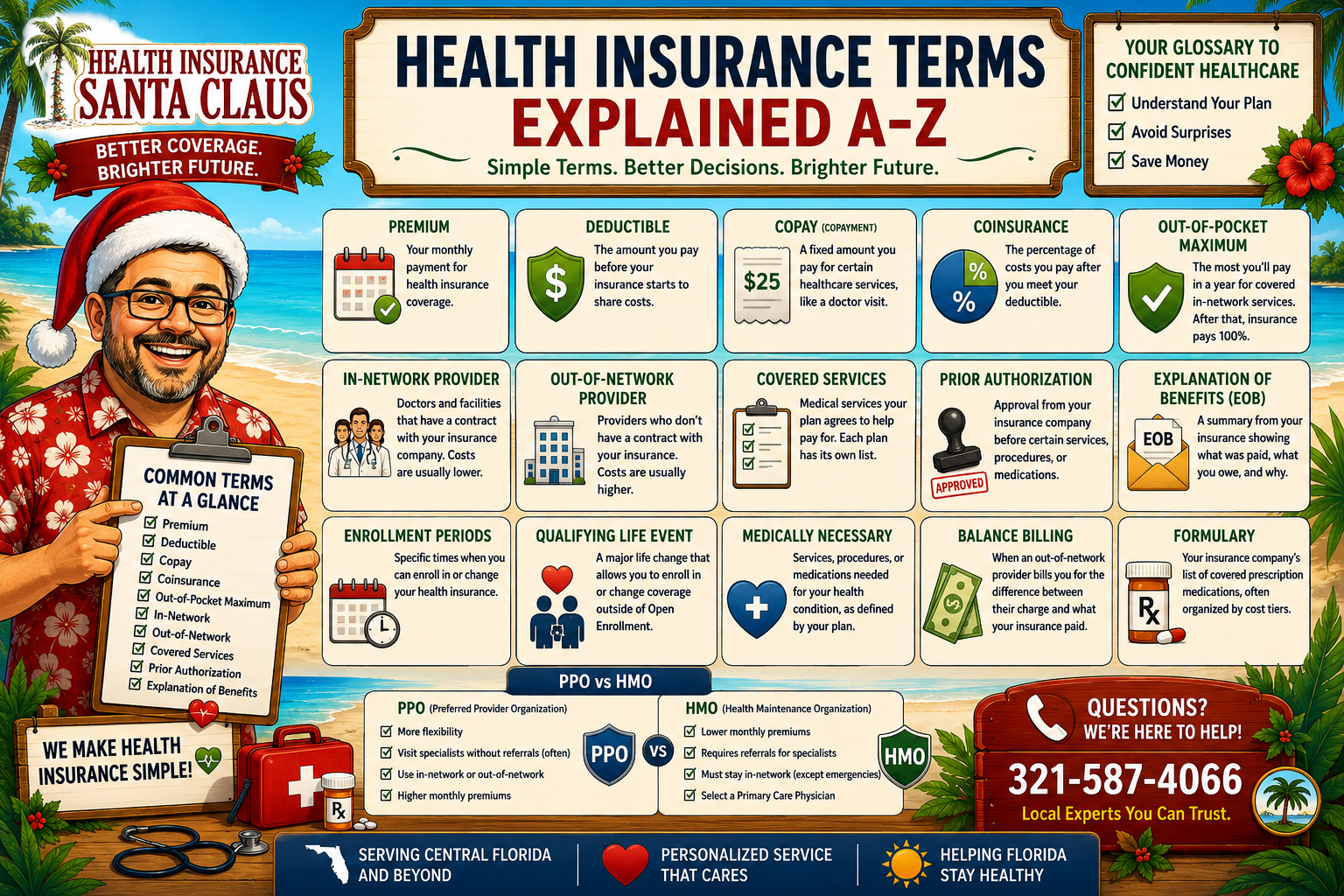
If you've ever looked at a health insurance brochure and felt like it was written in another language, you're not alone.
Insurance companies often use technical terms that can make comparing plans confusing. Understanding these terms will help you make better decisions, ask the right questions, and avoid unexpected medical bills.
This glossary explains the most common health insurance terms in simple language.
Allowed Amount
The allowed amount is the maximum amount your insurance company agrees to pay for a covered medical service.
For example:
A doctor bills $300 for an office visit.
Your insurance company's negotiated rate is $175.
The allowed amount is $175.
If the doctor is in-network, they generally cannot bill you for the remaining $125 (except for your normal cost-sharing).
Annual Enrollment Period (AEP)
The Annual Enrollment Period (AEP) is the time each year when certain people can enroll in or make changes to their health insurance.
For Medicare, AEP generally runs from October 15 through December 7.
During this time, eligible beneficiaries may:
- Change Medicare Advantage plans
- Switch Part D prescription drug plans
- Return to Original Medicare
- Enroll in new coverage
Appeal
An appeal is your formal request asking an insurance company to reconsider a decision when they deny payment or refuse coverage for a medical service.
If you believe a service should have been covered, you have the right to appeal.
Balance Billing
Balance billing happens when an out-of-network provider charges you the difference between their full fee and what your insurance company paid.
This is one reason why staying in-network can save you significant money.
Beneficiary
A beneficiary is the person receiving health insurance benefits.
For Medicare, the beneficiary is the person enrolled in Medicare.
Carrier
A carrier is simply another name for an insurance company.
Examples include companies that offer health insurance plans throughout Florida and the United States.
Claim
A claim is the request submitted to your insurance company asking them to pay for covered medical services.
Most healthcare providers file claims electronically for you.
Coinsurance
Coinsurance is the percentage of medical costs you pay after you've met your deductible.
Example:
Medical bill: $5,000
Insurance pays 80%
You pay 20%
Your responsibility would be $1,000.
Copayment (Copay)
A copay is a fixed dollar amount you pay for certain healthcare services.
Examples include:
- $25 Primary Care Visit
- $50 Specialist Visit
- $15 Generic Prescription
- $75 Urgent Care
Unlike coinsurance, copays are fixed amounts.
Coordination of Benefits (COB)
Coordination of Benefits determines which insurance company pays first when you have more than one health insurance policy.
For example:
- Employer insurance + Medicare
- Two employer plans
- Parent and child coverage
This prevents duplicate payments.
Cost Sharing
Cost sharing refers to the expenses you share with your insurance company.
These include:
- Deductibles
- Copays
- Coinsurance
Covered Services
Covered services are medical services your insurance policy agrees to help pay for.
Every health insurance policy has its own list of covered benefits.
Deductible
A deductible is the amount you generally pay each year before insurance begins sharing certain healthcare costs.
Example:
Deductible = $3,000
If you incur $3,000 in covered medical expenses, you pay that amount first.
Afterward, your insurance begins paying according to your policy.
Dependent
A dependent is someone eligible to receive coverage through another person's health insurance policy.
Dependents often include:
- Spouses
- Children
- Adopted children
- Stepchildren
Eligibility rules vary by plan.
Durable Medical Equipment (DME)
Durable Medical Equipment includes medically necessary equipment such as:
- Wheelchairs
- Walkers
- Oxygen equipment
- Hospital beds
- CPAP machines
- Diabetic supplies
Many insurance plans help cover these items.
Emergency Medical Condition
An emergency medical condition is an illness or injury requiring immediate medical attention to prevent serious harm.
Examples include:
- Heart attack
- Stroke
- Severe bleeding
- Difficulty breathing
- Major trauma
Most insurance plans provide emergency coverage regardless of network.
Enrollment Period
An enrollment period is the timeframe during which you can enroll in or change health insurance coverage.
Different types include:
- Open Enrollment
- Annual Enrollment
- Initial Enrollment
- Special Enrollment
We'll explain these in more detail later in this guide.
Essential Health Benefits
Under the Affordable Care Act (ACA), many health insurance plans must cover essential health benefits, including:
- Emergency services
- Hospitalization
- Maternity care
- Prescription drugs
- Mental health services
- Preventive care
- Pediatric services
- Laboratory services
- Rehabilitative services
Explanation of Benefits (EOB)
An Explanation of Benefits is not a bill.
It is a summary sent by your insurance company showing:
- What services were provided
- What the provider charged
- What insurance paid
- What you may owe
Always review your EOB for accuracy.
Formulary
A formulary is your insurance company's list of covered prescription medications.
Drugs are often organized into tiers.
Generally:
Tier 1 = Lowest cost
Higher tiers = Higher costs
Generic Drug
A generic medication contains the same active ingredients as a brand-name drug but usually costs much less.
Insurance companies often encourage using generic medications when appropriate.
Health Insurance Marketplace
The Health Insurance Marketplace is where eligible individuals can shop for ACA-compliant health insurance plans and determine whether they qualify for premium tax credits based on income.
In-Network Provider
An in-network provider has a contract with your insurance company.
Using in-network doctors usually means:
- Lower costs
- Lower deductibles
- Lower coinsurance
- Less paperwork
Initial Enrollment Period (IEP)
The Initial Enrollment Period is your first opportunity to enroll in Medicare.
For most people, it begins three months before turning 65 and ends three months after their birthday month.
Missing this enrollment window could result in penalties or delays in coverage.
Medical Necessity
Insurance companies often require services to be considered medically necessary before they will pay for them.
Medical necessity is determined according to your policy and accepted medical guidelines.
Network
A network is the group of doctors, hospitals, specialists, pharmacies, and healthcare providers that have contracted with your insurance company.
Larger networks often provide greater flexibility when choosing providers.
Open Enrollment Period (OEP)
Open Enrollment is the annual period when many individuals can enroll in Marketplace health insurance or make changes to their coverage.
Outside of Open Enrollment, you typically need a qualifying life event to enroll.
Out-of-Network Provider
An out-of-network provider has not contracted with your insurance company.
Depending on your plan:
- You may pay significantly more.
- Certain plans may not provide any coverage.
- Balance billing may apply.
Always verify whether your provider participates in your plan's network before receiving non-emergency care.
Out-of-Pocket Maximum
Your out-of-pocket maximum is the most you'll pay during a plan year for covered, in-network services.
Once you reach this limit, your health plan generally pays 100% of covered in-network medical expenses for the remainder of the plan year.
Policyholder
The policyholder is the individual who owns the health insurance policy.
Dependents may receive coverage under that policy.
PPO (Preferred Provider Organization)
A PPO offers flexibility by allowing you to:
- Visit specialists without referrals (in many cases)
- See both in-network and out-of-network providers (usually at different costs)
- Choose from a broader provider network
PPO plans are popular with individuals who value provider choice.
HMO (Health Maintenance Organization)
An HMO generally requires you to:
- Select a primary care physician (PCP)
- Obtain referrals for many specialists
- Stay within the provider network except for emergencies
HMOs often have lower premiums but more restrictions.
EPO (Exclusive Provider Organization)
An EPO combines features of PPO and HMO plans.
Typically:
- No referrals required
- Must remain in-network except for emergencies
POS (Point of Service)
A POS plan requires a primary care physician but allows some out-of-network coverage under certain circumstances.
Premium
Your premium is the monthly amount you pay to maintain health insurance coverage.
Think of it as your membership fee for having insurance.
Preventive Care
Preventive care focuses on identifying health issues before they become serious.
Common preventive services include:
- Annual wellness visits
- Vaccinations
- Mammograms
- Colon cancer screenings
- Blood pressure screenings
- Cholesterol testing
- Diabetes screenings
Many preventive services are covered at no additional cost when provided by in-network providers, depending on your plan.
Prior Authorization
Prior authorization means your insurance company requires approval before certain medical services, procedures, medications, or imaging studies will be covered.
Failing to obtain prior authorization when required could result in denied claims.
Primary Care Physician (PCP)
A primary care physician is your main healthcare provider for routine medical care.
A PCP often coordinates referrals to specialists when needed.
Provider
A provider is any licensed healthcare professional or facility that delivers medical services.
Providers include:
- Physicians
- Nurse practitioners
- Physician assistants
- Hospitals
- Urgent care centers
- Imaging centers
- Laboratories
Qualifying Life Event (QLE)
A qualifying life event allows you to enroll in or change health insurance outside of the normal Open Enrollment Period.
Common qualifying life events include:
- Marriage
- Divorce
- Birth or adoption of a child
- Loss of employer coverage
- Moving to a new service area
- Certain changes in household income or eligibility
Referral
Some health plans require a referral from your primary care physician before you can see a specialist.
PPO plans generally offer more flexibility than HMO plans in this area.
Specialist
A specialist is a healthcare provider with advanced training in a specific area of medicine, such as:
- Cardiology
- Dermatology
- Orthopedics
- Oncology
- Neurology
Depending on your plan type, you may or may not need a referral to see a specialist.
Subscriber
The subscriber is the person who enrolls in and is financially responsible for the health insurance policy.
Dependents receive coverage through the subscriber's plan when eligible.
Understanding These Terms Helps You Make Better Decisions
Learning health insurance terminology may seem overwhelming at first, but understanding these definitions can make comparing plans much easier. Instead of focusing only on the monthly premium, you'll be able to evaluate deductibles, provider networks, prescription coverage, and your overall financial exposure.
At the Health Insurance Santa Claus, we believe that an educated client is an empowered client. Taking the time to understand these common insurance terms can help you choose coverage that fits your healthcare needs, your budget, and your long-term financial goals.