



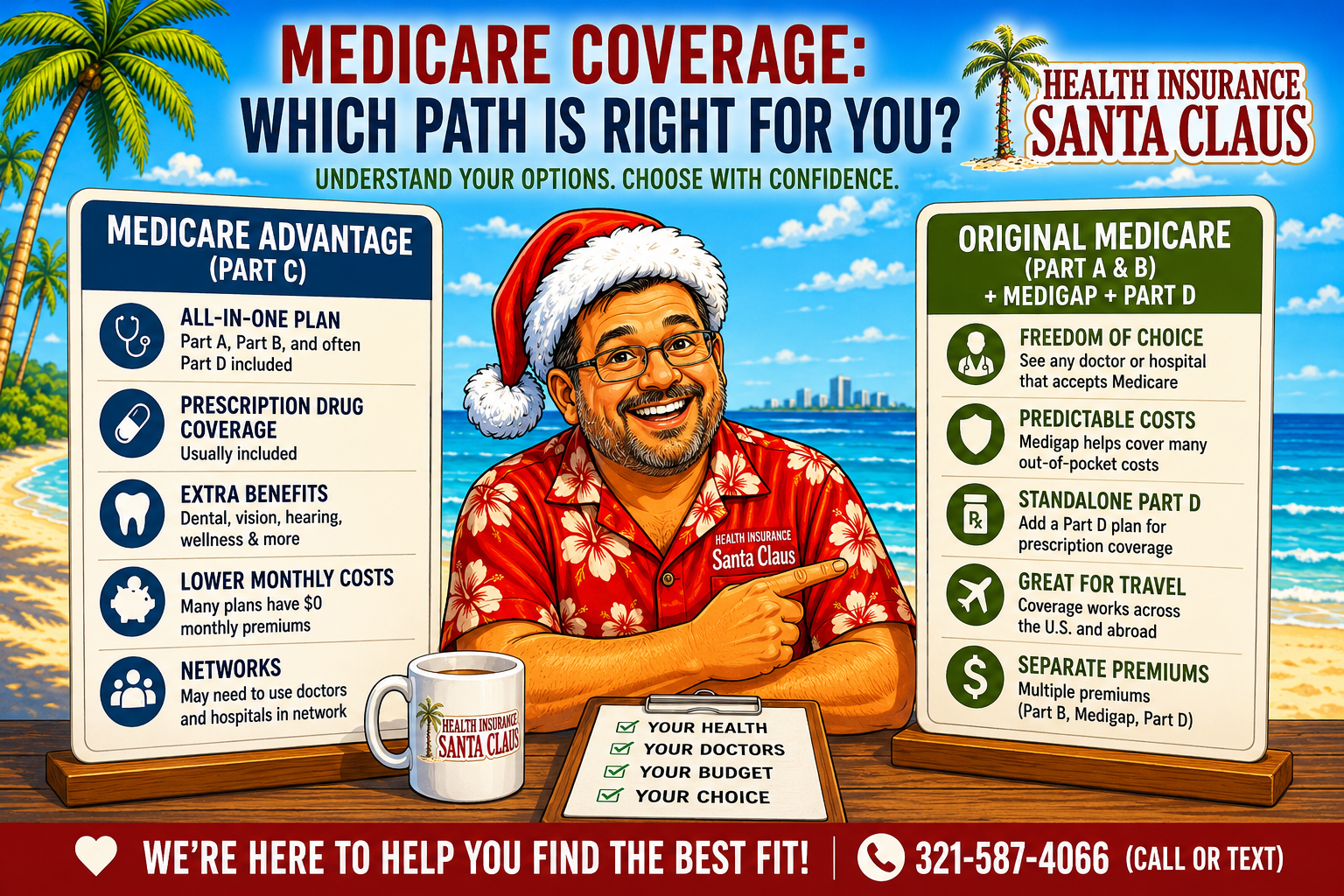
Medicare Options:
Understanding Your Coverage Choices
Whether you're approaching age 65, qualifying for Medicare because of a disability, or simply planning ahead, understanding your Medicare options is one of the most important financial and healthcare decisions you'll make.
At Health Insurance Santa Claus, we believe Medicare shouldn't be confusing. Our goal is to educate you about your options so you can make an informed decision based on your healthcare needs, prescription medications, preferred doctors, travel habits, and budget.
Important: Medicare plan availability, premiums, provider networks, and benefits vary by location and insurance carrier. Always review your options carefully before enrolling.
What Is Medicare?
Medicare is a federal health insurance program administered by the Centers for Medicare & Medicaid Services (CMS). It primarily serves:
- Individuals age 65 and older
- Certain people under age 65 with qualifying disabilities
- Individuals with certain qualifying medical conditions
Original Medicare consists of Part A and Part B, while additional coverage options include Part C (Medicare Advantage), Part D (Prescription Drug Plans), and Medicare Supplement (Medigap) policies. Information about Medicare benefits and enrollment is available directly through Medicare.gov and CMS.
Medicare Part A (Hospital Insurance)
Medicare Part A primarily helps cover inpatient hospital care.
Part A may help pay for:
- Inpatient hospital stays
- Skilled nursing facility care (when Medicare requirements are met)
- Hospice care
- Limited home health services
Many people qualify for premium-free Part A if they or their spouse paid Medicare taxes for a sufficient number of working years. Others may be required to pay a monthly premium depending on their work history. Coverage, deductibles, and eligibility requirements are established by Medicare and may change over time.
Medicare Part B (Medical Insurance)
Part B covers many medically necessary outpatient services and preventive care.
Common services include:
- Primary care physician visits
- Specialist appointments
- Preventive screenings
- Laboratory services
- Outpatient procedures
- Durable medical equipment
- Physical therapy
- Mental health services
Part B generally requires a monthly premium and cost-sharing such as deductibles and coinsurance. Enrollment timing is important because delaying Part B without qualifying coverage may result in a late enrollment penalty.
Medicare Part C (Medicare Advantage)
Medicare Advantage plans are offered by private insurance companies approved by Medicare.
These plans provide all Medicare Part A and Part B benefits while often including additional services.
Many Medicare Advantage plans may include:
- Prescription drug coverage
- Routine dental benefits
- Vision benefits
- Hearing benefits
- Fitness programs
- Wellness programs
- Telehealth services
- Additional supplemental benefits (varies by plan)
Medicare Advantage plans typically use provider networks such as HMOs or PPOs, meaning costs and provider access can vary depending on the specific plan.
Each plan has its own:
- Monthly premium
- Copayments
- Provider network
- Prescription drug formulary
- Maximum out-of-pocket limit
Benefits vary by insurance company and county, making annual plan reviews especially important. Medicare Advantage plans are required to provide at least the same level of coverage as Original Medicare for covered services, although they may do so under different rules and cost-sharing structures.
Medicare Part D (Prescription Drug Coverage)
Medicare Part D helps pay for covered prescription medications.
Prescription drug plans are available through private insurance companies approved by Medicare and are available in two primary ways:
- As a standalone Part D plan paired with Original Medicare
- Included with many Medicare Advantage plans
Each Part D plan has its own:
- Covered drug list (formulary)
- Pharmacy network
- Premium
- Deductible
- Copayments
Reviewing your medications every year can help ensure your prescriptions remain covered under your selected plan.
Medicare Supplement Insurance (Medigap)
Original Medicare generally does not pay all healthcare expenses.
Medicare Supplement Insurance, also known as Medigap, is designed to help pay certain out-of-pocket costs associated with Original Medicare.
Depending on the plan selected, a Medicare Supplement policy may help pay for:
- Medicare deductibles
- Coinsurance
- Copayments
- Certain additional costs covered under standardized Medigap benefits
Medigap policies work alongside Original Medicare and do not replace it. You must generally be enrolled in both Medicare Part A and Part B to purchase a Medigap policy. These policies are standardized under federal rules, although availability can vary by state.
Hospital Indemnity Insurance
Hospital Indemnity Insurance is separate from Medicare and is considered supplemental insurance.
These policies may provide cash benefits for covered hospital-related events, depending on the policy terms.
Benefits may help with expenses such as:
- Hospital admissions
- Overnight hospital stays
- Intensive care unit (ICU) stays
- Recovery-related costs
Because Original Medicare, Medicare Advantage, and Medigap plans all have different cost-sharing structures, some beneficiaries choose Hospital Indemnity Insurance as an additional layer of financial protection.
Coverage varies significantly by carrier and policy.
Dental, Vision, and Hearing Coverage
Many people are surprised to learn that Original Medicare generally does not cover routine:
- Dental exams
- Cleanings
- Dentures
- Routine eye exams
- Eyeglasses
- Hearing exams
- Hearing aids
Individuals seeking these benefits often consider:
- Medicare Advantage plans that include dental, vision, and hearing benefits
- Stand-alone dental insurance
- Stand-alone vision insurance
- Stand-alone hearing benefit programs
Coverage levels differ by plan, and benefit amounts, provider networks, and limitations vary.
Which Medicare Option Is Right for You?
There is no one-size-fits-all Medicare solution.
The right choice depends on factors such as:
- Your current health
- Prescription medications
- Preferred physicians
- Specialists you see
- Travel habits
- Budget
- Desired flexibility
- Anticipated healthcare needs
Some individuals prefer the flexibility of Original Medicare combined with a Medicare Supplement policy, while others appreciate the bundled convenience offered through Medicare Advantage plans.
Reviewing your coverage regularly can help ensure it continues to meet your needs.
Why Work With Health Insurance Santa Claus?
Choosing Medicare coverage doesn't have to be overwhelming.
Health Insurance Santa Claus is committed to helping individuals understand their Medicare options through education and personalized guidance. We'll take the time to explain the differences between Medicare Parts A, B, C, and D, Medicare Supplement Insurance, Hospital Indemnity coverage, and Dental, Vision, and Hearing options so you can make an informed decision with confidence.
Whether you're new to Medicare or reviewing your current coverage, we're here to help simplify the process and answer your questions.
Frequently Asked Questions
What is the difference between Original Medicare and Medicare Advantage?
Original Medicare consists of Part A and Part B and is administered by the federal government. Medicare Advantage plans are offered by private insurance companies approved by Medicare and provide Part A and Part B benefits, often with additional benefits such as prescription drug coverage and routine dental, vision, and hearing services.
Do I need a Medicare Supplement plan?
Medicare Supplement (Medigap) policies are optional. They are designed to help pay certain out-of-pocket costs not covered by Original Medicare. These policies are available only to individuals enrolled in Original Medicare Parts A and B.
Does Medicare cover dental, vision, and hearing?
Original Medicare generally does not cover routine dental, vision, or hearing services. Some Medicare Advantage plans may include these benefits, and separate insurance options may also be available.
Can I have both Medicare Advantage and Medigap?
No. Federal rules generally do not allow you to use a Medicare Supplement (Medigap) policy with a Medicare Advantage plan. Medigap policies are designed to work only with Original Medicare.